पत्ती
Nine Rare Classic Wagons You’ve Probably Never Heard of Available
Long before crossovers and minivans became the default family vehicles, full-size station wagons ruled the roads. Even today, it’s difficult to understand why SUVs have largely replaced wagons, considering that wagons often deliver better handling, improved fuel economy, and lower ownership costs thanks to their lower ride height, lighter construction, and more aerodynamic designs.
Rowan Ellis
लेखक
झलक
नीचे पूरा पाठ फ़्लोट करता है।
शेल्फ़
स्टोरी लीफ़

Long before crossovers and minivans became the default family vehicles, full-size station wagons ruled the roads. Even today, it’s difficult to understand why SUVs have largely replaced wagons, considering that wagons often deliver better handling, improved fuel economy, and lower ownership costs thanks to their lower ride height, lighter construction, and more aerodynamic designs.
For this collection, we’re skipping the famous wagon legends such as the Ford Country Squire, Chevrolet Nomad, Buick Estate Wagon, Oldsmobile Vista Cruiser, and Volvo 240/740. Instead, we’re shining a spotlight on a selection of uncommon and often overlooked station wagons that many enthusiasts may have never encountered.
1967 Citroën DS21 Safari
The 1967 Citroën DS21 Safari combined futuristic French styling, advanced engineering, and everyday practicality in a way few automobiles could match. As the wagon version of the groundbreaking DS, it inherited innovations such as the self-leveling hydropneumatic suspension and sleek aerodynamic bodywork, resulting in an exceptionally smooth ride regardless of road conditions or cargo weight.
Inside, the Safari offered enormous passenger and cargo space, featuring a split-opening tailgate and optional inward-facing auxiliary seats. It served many purposes, from family transportation to emergency medical service vehicles. Today, the DS21 Safari remains one of the most celebrated examples of automotive innovation, with technology that seemed decades ahead of its time. Very few reached American shores, making surviving examples exceptionally rare. Chassis number 3554921 is believed to be among a small fraction of the roughly 38,000 Citroëns of all types sold in the United States during that period.
1963 Rambler Ambassador Wagon
The 1963 Rambler Ambassador Wagon challenged the industry's obsession with oversized automobiles by offering a more efficient and thoughtfully designed family vehicle. Built on a longer wheelbase than previous models, it provided increased interior room while maintaining manageable proportions.
American Motors incorporated its innovative Uniside body construction, which improved structural strength and reduced noise levels. The Ambassador successfully blended practicality with attractive styling and modern conveniences, including available V8 engines and power-assisted features. The stylish Ambassador 990 wagon represented a refined approach to family transportation while remaining true to AMC’s reputation for value and efficiency.
1960 Plymouth Suburban
The 1960 Plymouth Suburban perfectly captured the optimism and futuristic styling trends of the Jet Age. Constructed using advanced unit-body engineering, it combined family-friendly practicality with dramatic design elements, including prominent tailfins that remained distinctive despite being toned down from earlier years.
The interior was equally memorable, highlighted by a uniquely shaped oval steering wheel and an instrument panel that looked straight out of a science-fiction movie. Families appreciated the roomy cabin and optional third-row seating, allowing capacity for up to nine occupants. Power came from Plymouth’s newly introduced 225-cubic-inch Slant-Six engine, a remarkably durable powerplant that would remain in production for decades. Push-button transmission controls further reinforced the Suburban’s reputation as an innovative and unconventional family wagon.
1955 Mercury Medalist Custom Wagon
Introduced as a step above Ford’s offerings, the 1955 Mercury Medalist Custom Wagon filled the gap between basic transportation and luxury motoring. It was ideally suited to the growing American family while presenting a stylish image.
Its broad grille, extensive chrome accents, and optional two-tone paint schemes reflected the optimism of the 1950s. Decorative woodgrain trim paid tribute to traditional wagon designs. Under the hood sat Mercury’s dependable 292-cubic-inch V8, paired with the smooth-shifting Merc-O-Matic automatic transmission. Combining comfort, performance, and visual appeal, the Medalist Custom Wagon became a memorable symbol of an era when automobiles were both transportation and artistic expression.
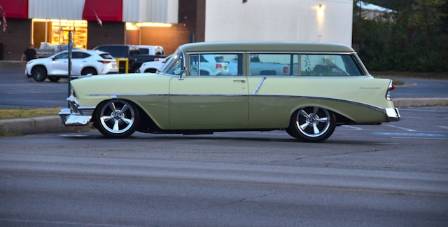
1956 Nash Rambler Cross Country Wagon
The 1956 Nash Rambler Cross Country Wagon broke new ground by emphasizing efficiency, practicality, and innovation rather than excess. Produced shortly after the formation of American Motors Corporation, it retained Nash branding while introducing several industry-first features.
Most notably, it became the first four-door hardtop station wagon sold in America. Its pillarless side design improved visibility and gave the vehicle a more open appearance. Another groundbreaking feature was the electrically operated retractable rear window, which allowed easy cargo access without requiring the entire tailgate to be opened. These innovations helped establish the Cross Country Wagon as one of the most forward-thinking wagons of its era.
1972 Volkswagen Type 4 Wagon
Known as the 411 Variant, the 1972 Volkswagen Type 4 Wagon represented Volkswagen’s final effort to build a large air-cooled, rear-engine passenger vehicle before transitioning to water-cooled, front-engine designs such as the Passat.
Styled with input from Pininfarina, the Type 4 introduced several significant engineering advances for Volkswagen. These included independent suspension with MacPherson struts, a fully unitized body structure, and a larger 1.7-liter flat-four engine. In the American market, this engine featured Bosch D-Jetronic fuel injection. Variants of the same powerplant would later power the Porsche 914, creating an intriguing connection between this practical wagon and a respected sports car.
1984 Pontiac Parisienne Wagon
The 1984 Pontiac Parisienne Wagon serves as a fascinating example of General Motors’ badge-engineering strategy during the 1980s. Essentially a Canadian-built Chevrolet Caprice wearing Pontiac badges, it filled a gap in Pontiac’s lineup after the discontinuation of larger Bonneville and Catalina models.
The Parisienne retained traditional American full-size car characteristics, including body-on-frame construction, a soft and comfortable ride, and upscale interior options featuring velour or leather upholstery. Available as both a sedan and station wagon, it was powered by a reliable 5.0-liter V8 engine. While it prioritized comfort and practicality over outright performance, the Parisienne Wagon represented one of the final chapters of classic full-size Pontiac motoring before the market shifted toward smaller vehicles and, eventually, SUVs.
1990 Lada VAZ 2104 Wagon
The 1990 Lada VAZ 2104 Wagon stands as a durable reminder of Soviet-era automotive philosophy, where simplicity and toughness were valued above luxury and sophistication. Derived from a heavily reworked version of the Fiat 124, it was specifically adapted to withstand harsh weather conditions and rough road surfaces throughout the USSR.
Engineers strengthened the body structure, developed a robust overhead-cam engine for long-term durability, and equipped the vehicle with an effective heating system. The VAZ 2104 became a dependable workhorse across Eastern Europe, offering a spacious cargo area and folding rear seats that enhanced its practicality. Surviving original examples are uncommon in the United States, making well-preserved vehicles particularly noteworthy.
1996 Nissan Stagea Wagon
The 1996 Nissan Stagea earned legendary status among Japanese performance enthusiasts by combining station wagon practicality with the mechanical components of Nissan’s famous Skyline lineup. Beneath its family-friendly exterior, buyers could find turbocharged RB-series engines and the sophisticated ATTESA all-wheel-drive system derived from the legendary GT-R.
The result was a spacious and comfortable wagon capable of delivering serious performance. Models such as the RS Four V became especially desirable thanks to their tuning potential and impressive capabilities. The Stagea’s blend of cargo-carrying versatility and sports-car engineering earned it a reputation as one of the ultimate sleeper wagons of the 1990s.
For wagon enthusiasts, these lesser-known models demonstrate just how diverse and innovative the station wagon segment once was, offering everything from advanced French engineering and Soviet durability to Japanese performance and classic American comfort.

पास की पत्तियाँ

Exploring the World's Most Captivating Coral Reefs
Alexander Reed
क्वार्ट्ज 10 सबसे प्रतिष्ठित क्लासिक कारें जो अभी भी मूल्यवान हैं
पार्वती
कॉफी और विभिन्न संस्कृतियों में इसकी भूमिका
अंकित

Fantastic Facts About Red Pandas
Oscar Wells

Bagel Avocado Toast with Salmon
Lillian Pembroke

आप मिल्की वे को कहाँ देख सकते हैं? – दुनिया की 10 बेहतरीन जगहें
इन्द्रेश