पत्ती
Fantastic Facts About Red Pandas
Red pandas are extraordinary animals with traits that make them truly one-of-a-kind. They are also vital to maintaining biodiversity, serving as both a flagship species and an ecological indicator for the Eastern Himalayan Broadleaf Forest Ecoregion — a biodiversity hotspot that supports over 500 million people.
Oscar Wells
लेखक
झलक
नीचे पूरा पाठ फ़्लोट करता है।
शेल्फ़
स्टोरी लीफ़
Red pandas are extraordinary animals with traits that make them truly one-of-a-kind. They are also vital to maintaining biodiversity, serving as both a flagship species and an ecological indicator for the Eastern Himalayan Broadleaf Forest Ecoregion — a biodiversity hotspot that supports over 500 million people.
Protecting red pandas helps safeguard entire landscapes, including the forests and wildlife that share their habitat. Here are fifteen fascinating facts about red pandas!
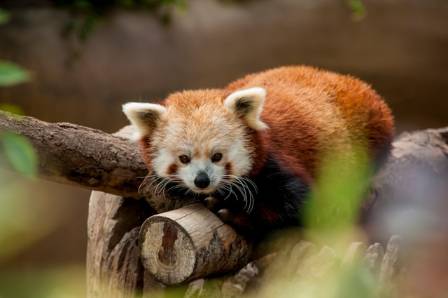
1. The Original Panda
The red panda was described in 1825 by French zoologist Frédéric Cuvier, nearly 50 years before the giant panda was known. He considered it one of the most beautiful animals he had ever seen. Cuvier documented the western red panda (Ailurus fulgens fulgens). Later, in 1897, F. W. Styan identified another subspecies (Ailurus fulgens styani, now refulgens). This makes the red panda the first panda.
2. Not Close Relatives of Giant Pandas
Despite the name, red pandas are not closely related to giant pandas. Genetic studies show they are more closely aligned with raccoons and, in some classifications, with the Mustelidae family (weasels, otters, and wolverines).
3. Bamboo Lovers
Bamboo forms around 98% of their diet. Red pandas must eat 20–30% of their body weight in bamboo daily. Because bamboo is low in calories but abundant in their cloud forest habitat, it provides a reliable food source with little competition. Occasionally, they will also consume eggs, insects, flowers, birds, and small mammals.
4. Many Names
Red pandas are known as the “lesser panda,” “firefox,” “red bear-cat,” and “red cat-bear,” reflecting their unique appearance and charm.
5. Part Bear, Part Cat
Red pandas have traits similar to both cats and bears. Cubs are called cubs, like bear offspring, and stay in dens for the first three months. Mothers keep their young clean with their tongues and carry them by the neck, much like felines, curling them into a ball for safety during transport.
6. Technically Carnivores
Red pandas are classified as carnivores, descended from ancestors like Simocyon batalleri, a short-snouted, tree-dwelling carnivore the size of a mountain lion that lived millions of years ago in Europe, Asia, and North America.
7. Six Digits on Front Paws
Red pandas have a pseudo-thumb — an extra digit formed from a modified wrist bone — which helps them climb trees and grasp bamboo. Giant pandas have a similar adaptation, developed independently through convergent evolution.
8. Sleep Experts
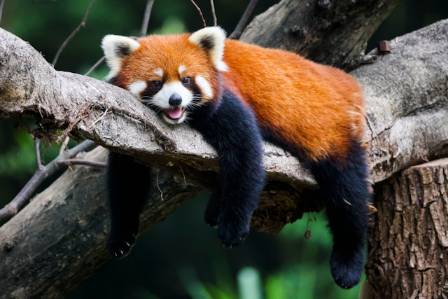
Red pandas spend up to 17 hours a day resting. They are nocturnal and crepuscular, often sleeping on branches or in tree hollows.
9. Tail Blankets
Their long, bushy tails (12–20 inches) provide balance while moving through trees and act as cozy wraps to stay warm in their chilly mountain homes.
10. Quirky Sounds
Red pandas are usually quiet but can make tweets, squeals, grunts, hisses, and a distinctive “huff-quack.”
11. Camouflage Masters
Their reddish fur blends with moss, lichen, and autumn foliage, while their dark bellies make them harder to spot from below.
12. Glowing Faces
The white markings on a red panda’s face help lost cubs find their mother. The reddish “tear tracks” from eyes to mouth may also reduce glare from the sun.
13. Stand Tall
When threatened, red pandas rise on their hind legs to appear larger.
14. Hibernate in Cold Weather
To conserve energy during harsh winters, red pandas can enter a state of torpor, lowering their metabolism, body temperature, and breathing rate. Bamboo’s low nutritional value makes this adaptation essential.
15. Seasonal Migration
Red pandas inhabit forests at 4,900–13,000 feet elevation and move lower during cold months to find more favorable conditions.
Through our Fifteen for the First Panda campaign, you can make a real difference. For $15 a month, become a Panda Guardian and support sustainable livelihoods in Nepal, helping protect red panda habitats, combat poaching, and address gender inequality in local communities.
पास की पत्तियाँ
The Remarkable World of the Praying Mantis
Grayson Oliver Caldwell

20 पुरानी यादें जो मुझे बूढ़ा होने का एहसास कराती हैं
दिवाकर

दुनिया भर में शीर्ष 10 मनमोहक झूले, जिनमें लुभावने दृश्य हैं
विक्टोरिया

10 fascinating facts about geese
William Carter

The Future of Communications: 10 Pivotal Ways AI Will Reshape How We Connect
Andrew Harris

एक पालतू जानवर होने के 8 स्वास्थ्य लाभ
स्केलेय