पत्ती
The Remarkable World of the Praying Mantis
While the praying mantis often appears tranquil and meditative—owing to the way its forelegs fold as if in prayer—it is actually one of the most efficient ambush predators in the insect kingdom. There are approximately 2,000 species of mantises globally, each possessing a unique set of adaptations that allow them to dominate their respective environments with speed, stealth, and precision.
Grayson Oliver Caldwell
लेखक
झलक
नीचे पूरा पाठ फ़्लोट करता है।
शेल्फ़
स्टोरी लीफ़
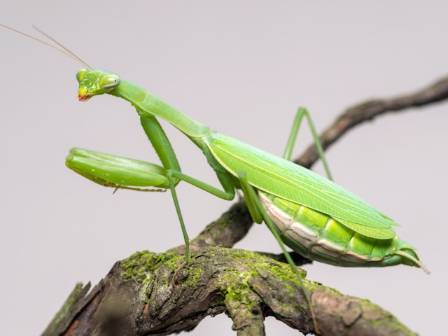
While the praying mantis often appears tranquil and meditative—owing to the way its forelegs fold as if in prayer—it is actually one of the most efficient ambush predators in the insect kingdom. There are approximately 2,000 species of mantises globally, each possessing a unique set of adaptations that allow them to dominate their respective environments with speed, stealth, and precision.
Advanced Sensory and Physical Capabilities
One of the most significant advantages a mantis has is its extraordinary vision. These insects possess "stereo vision," allowing them to track movement with high acuity. Recent research has revealed that their 3-D perception works through a biological mechanism unlike any other found in nature, a discovery that is currently helping scientists improve robotic visual systems.
Beyond their sight, mantises are unique among insects for their ability to rotate their heads from side to side. This anatomical flexibility allows them to scan for prey or threats without moving their bodies, maintaining the stillness required for a successful ambush. They also exhibit surprising feline-like athleticism; when jumping, a mantis can twist its body mid-air to land with extreme precision on a specific target.
Masterful Hunting and Camouflage
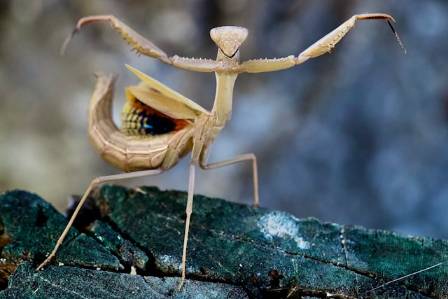
The hunting style of the praying mantis is defined by patience followed by explosive action. They strike with their spiked front legs so rapidly that the movement is nearly invisible to the human eye, using the barbs to pin their victims instantly. While they are beneficial to gardeners for eating pests like crickets and beetles, they are unselective carnivores and will also consume helpful pollinators like bees.
Their survival is also tied to their brilliance in disguise. Mantises have evolved to mimic leaves, sticks, and even flowers to lure unsuspecting insects looking for nectar. Some species have even adapted to environmental changes; certain mantises molt into a black coloration following dry-season brush fires to blend into the charred landscape.
Complex Survival and Mating Behaviors
Despite their small size, mantises are ambitious predators. Their diet is not limited to other insects; larger species have been observed hunting hummingbirds, frogs, lizards, and even small rodents. However, they are also part of a complex food chain and must defend themselves against birds, snakes, and bats. To escape bats, mantises can detect echolocation frequencies and perform evasive aerial loops and spirals to reach the ground safely.
The life of a male mantis is particularly perilous during the breeding season. Between 13% and 28% of mating encounters involve sexual cannibalism, where the female consumes the male's head. Studies suggest this behavior serves an evolutionary purpose, as females who cannibalize their partners often produce a higher number of eggs, potentially increasing the success of the next generation.
पास की पत्तियाँ

Are Flavored Sparkling Waters Bad for You? The Science Behind Bubbly Drinks
Jackson

शुरुआती खिलाड़ियों के लिए 5 टेनिस टिप्स | अपने कौशल कैसे सुधारें
विकास

दुनिया के टॉप 10 सबसे अमीर शहर
सुमन

अंतरिक्ष की कल्पना
इशित

मिट्टी की मूर्तिकला मार्गदर्शिका: खोखली आकृतियाँ बनाने की विस्तृत तकनीकें
दिव्या शर्मा

शीर्ष राज्यों को पतन पर्णसमूह देखने के लिए
न्यू