← होम स्पेस3 मि.
पत्ती
Revitalizing Early Childhood Pedagogy
"Our sensory experiences serve as pioneers of the environment, clearing the path toward understanding." — Maria Montessori
L
Landy
लेखक
झलक
नीचे पूरा पाठ फ़्लोट करता है।
शेल्फ़
स्टोरी लीफ़
An Orientation to Watercolor Painting for Young Learners
"Our sensory experiences serve as pioneers of the environment, clearing the path toward understanding." — Maria Montessori
Within a Montessori-based curriculum, the arts are held in high regard, and this dedication is mirrored in our creative workspace. We prioritize giving youngsters consistent opportunities for imagination, innovation, and self-discovery through the medium of art.
Maria Montessori perceived painting as a highly functional endeavor; from her perspective, the aesthetic result is of secondary importance. Primarily, the practice of painting hones a student's dexterity by:
Fortifying the muscle groups in the palms, digits, and wrists
Encouraging the mastery of a correct writing hold
Managing the ratio of liquid to pigment on the tool
Refining the synchronization between visual input and hand movement
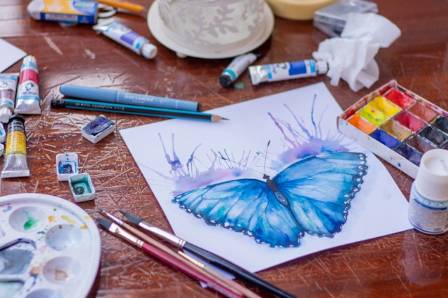
Establishing an understanding of physical space
Creating intentional shapes and lines on a surface
... all of which constitute the foundational abilities required for literacy and penmanship!
Beyond the advancement of these physical capabilities, we must also recognize how painting lessons familiarize a student with the fundamentals of color theory and introduce elements of experimental science through the blending of hues.
Required Supplies
Thick cardstock or specialized watercolor paper
A set of watercolor pigments
Several brushes in varying widths
A modest container for water
Paper towels for moisture control
A shallow bin or tray to manage spills
A protective smock or oversized shirt
Steps for Presenting Watercolors to Your Youngster
While you may choose any palette, we recommend starting with the foundational primary shades (yellow, blue, and red). Present these individually at the start, slowly introducing a new shade over time. This method maintains a high level of curiosity and allows the child to celebrate the arrival of each new option while discovering how colors merge.
Demonstrate the technique of saturating the bristles in the water container before applying them to a single pigment. For very young toddlers (under two years), a helpful strategy is to pre-moisten the paint cakes with a few drops of water, allowing them to simply touch the brush to the surface. You can still model the habit of rinsing the tool between shades, but pre-wetting the medium simplifies the initial steps.
Allow the student to experiment with marks on the page. Motivate them to vary the amount of liquid and pigment used to observe the differing effects.
Instruct the child to rinse the bristles thoroughly when switching colors and to use the paper towel for managing excess liquid or drips. If the brush becomes overly saturated, show them how to delicately blot the bristles against the towel.
Engaging Figurative Language for Instruction
Submerge the brush in the water so the bristles can take a long drink before they begin their work.
Lightly press the brush into the chosen shade and rotate it gently like a dancer spinning on a stage.
Guide the tool across the page as if it is moving to the rhythm of a song.
When the bristles appear dry, return them to the water container to sip like a tiny bird at a fountain.
Alternatively, utilizing a simple rhythmic phrase such as "water first, then the paint, then the page" helps reinforce the necessary sequence of wetting the tool before engaging with the colors.
The primary goal is to foster an environment of enjoyment, originality, and trial-and-error. Art should be viewed as a journey without rigid rules, acknowledging that every student is unique. Remain encouraging and patient, advocate for self-reliance, and permit the youngster to investigate the medium according to their own timeline!
पास की पत्तियाँ

en
Incredible Hidden Truths and Amazing Secrets About the Native Black Bears
Graham Lucy
hi
7 प्रकार के पनीर जिन्हें आपको अपना अगला ग्रिल्ड चीज़ बनाते समय लेना चाहिए
जयदीप
en
Elegant Woven Textiles are Returning to Modern Interior Decoration
Wesley Daniel Graham
hi
पक बैटल: माइंडसेट, टेक्निक और कैसे बेहतर करें
वरुण

hi
दुनिया की सबसे बेहतरीन सड़क यात्राएँ
पंकज
hi
सिएटल में टॉप 7 पब्लिक बास्केटबॉल कोर्ट
माधवी