पत्ती
Twelve Intriguing Realities of the Pallas’s Cat
The Pallas’s cat, frequently referred to as the manul, is a reclusive and strikingly fluffy wild feline that inhabits the high-altitude grasslands and steppes of Eurasia and Central Asia. Despite its charming and somewhat comical appearance, this small predator is a fierce and solitary survivor. From its unusual physical adaptations to its grumpy temperament, there is much to discover about this unique member of the cat family.
Noah Benjamin Hayes
लेखक
झलक
नीचे पूरा पाठ फ़्लोट करता है।
शेल्फ़
स्टोरी लीफ़
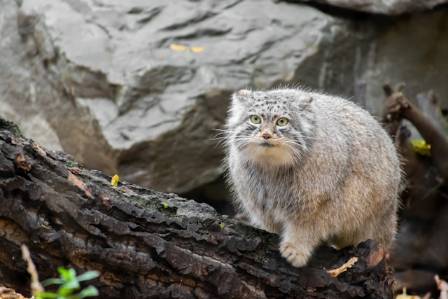
The Pallas’s cat, frequently referred to as the manul, is a reclusive and strikingly fluffy wild feline that inhabits the high-altitude grasslands and steppes of Eurasia and Central Asia. Despite its charming and somewhat comical appearance, this small predator is a fierce and solitary survivor. From its unusual physical adaptations to its grumpy temperament, there is much to discover about this unique member of the cat family.
Historical Naming and Scientific Classification
This feline first gained recognition in the scientific community in 1776 through the descriptions of German naturalist Peter Pallas. Initially, he categorized the animal as Felis manul and incorrectly speculated that it was a forefather of the modern Persian cat, citing its stout frame, flat face, and long fur as evidence. While his evolutionary theory was eventually debunked, the common name "Pallas’s cat" remained.
Later, the scientific community reclassified the species into its own genus, Otocolobus manul. The name Otocolobus originates from Greek and translates roughly to "ugly-eared." While the name is somewhat harsh, it highlights one of the cat's most distinctive physical traits.
Strategic Anatomical Features
The low-set, rounded ears of the manul are not merely an aesthetic quirk; they are a vital survival tool. Positioned flat on the sides of the head, these ears allow the cat to peer over rocky ledges or through tall grass while hunting without exposing its silhouette. This low profile ensures the predator remains hidden from both its prey and larger threats.
In addition to its ears, the Pallas’s cat possesses eyes with round pupils, a trait shared with large cats like tigers and leopards, rather than the vertical slits seen in domestic house cats. While the reason for this remains a topic of scientific debate, some researchers believe pupil shape is linked to an animal's ecological niche and whether it chases its prey or hunts from a stationary ambush position.
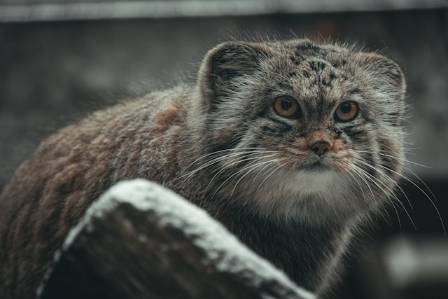
The World's Densest Feline Coat
The most prominent feature of the Pallas’s cat is its luxurious fur, which is denser and longer than that of any other felid. This coat serves as essential insulation against the frigid, arid climates of its habitat. Interestingly, the fur on its underside is twice as long as the fur on its back, providing a warm cushion when the cat crouches on frozen ground or snow.
This heavy coat also creates a visual illusion. While the Pallas’s cat appears quite large and stout, it actually weighs less than twelve pounds and is similar in size to a typical domestic cat. Its silvery-grey or reddish fur serves as excellent camouflage, allowing it to blend seamlessly into rocky terrain or dry vegetation. When threatened, the cat simply freezes and huddles close to the earth, effectively disappearing into the landscape.
Diet and Hunting Tactics
The manul is a master of the ambush, relying on stealth rather than speed. Its primary source of sustenance is the pika, a small mountain mammal that constitutes over half of its nutritional intake. When pikas are scarce, the cat targets other small animals such as voles, gerbils, hares, ground squirrels, and various birds. By hiding in crevices or abandoned burrows, it waits patiently for the perfect moment to strike.
Temperament and Social Isolation
Despite their soft and huggable appearance, Pallas’s cats are famously antisocial and aggressive. They lead solitary lives and avoid interaction with others of their kind whenever possible. This fierce nature is evident from birth; researchers have noted that even newborn kittens, whose eyes are not yet open, will instinctively growl and hiss at their siblings.
This antisocial behavior extends to their reproductive cycle, which features an extremely narrow mating window between December and March. Following a gestation period of roughly ten weeks, females typically produce a litter of three or four kittens. These young cats grow rapidly, achieving independence within five months and reaching full maturity by the time they are ten months old.
पास की पत्तियाँ
10 Things You Didn’t Know About Parrots
Jordan Miller

सार्वजनिक परिवहन का उपयोग करके 10 सर्वश्रेष्ठ यात्राएं
सिंडी
शीर्ष 10 खेत जानवर
ल्यूक यंग
Contemporary Wood Art Styles You Need to See
Peyton Grey

The romance and history of the message in a bottle
Edward Fairchild

दुनिया की 10 सबसे तेज़ हाई-स्पीड ट्रेनें
राज