पत्ती
Zephyranthes rosea: The Rain-Blooming Lily Explained
The genus name Zephyranthes is derived from Greek: zephyros, referring to the west wind (associated with the god Zephyrus), and anthos, meaning flower—together translating to “flower of the west wind.” Zephyrus is also linked to rain in mythology. The species name rosea comes from Latin, meaning “rose-colored.”
Jordan Smith
लेखक
झलक
नीचे पूरा पाठ फ़्लोट करता है।
शेल्फ़
स्टोरी लीफ़
General Information
The common name “rain lily” comes from the plant’s habit of flowering shortly after heavy rainfall.
The genus name Zephyranthes is derived from Greek: zephyros, referring to the west wind (associated with the god Zephyrus), and anthos, meaning flower—together translating to “flower of the west wind.” Zephyrus is also linked to rain in mythology. The species name rosea comes from Latin, meaning “rose-colored.”
Botanical Description
Zephyranthes rosea is a small, low-growing herb that lacks an obvious stem and forms a rosette-like structure. It develops from a tunicated, egg-shaped bulb.
The leaves are all basal, grass-like in appearance, smooth and glossy, linear in shape, and somewhat thick and fleshy.
The flowering stalk (scape) is upright, slightly flattened, and green, emerging as the bulb elongates during the flowering stage. It is typically a bit taller than the leaves and bears a single flower.
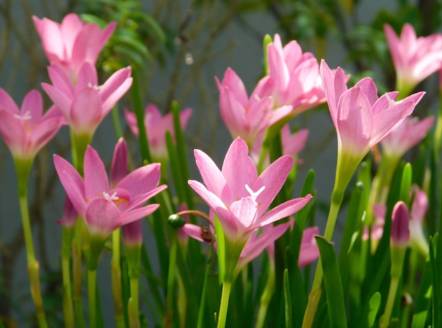
The flower has a pink to purplish perianth with a funnel-shaped tube approximately 4 cm long. It is divided into six oblong segments, each about 1–1.5 cm wide. The inner three segments are narrower, while the outer ones spread more widely.
There are six stamens with yellow anthers, and their filaments are attached near the throat of the floral tube. The slender style rises above the stamens and ends in a three-lobed stigma.
The ovary is divided into three chambers and develops into a roughly spherical capsule that splits into three valves when mature.
Distribution
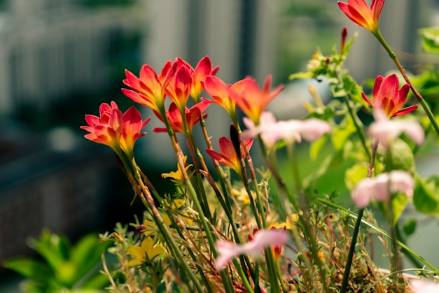
Introduced to the Philippines, where it is now commonly found at low to mid elevations
Widely cultivated as an ornamental species
Naturalized across tropical regions of the Americas, Asia, Australia, and some Pacific islands
Originally native to Colombia and Peru
Chemical Components
The bulbs contain several alkaloids, including lycorine, galanthamine, epimaritidine, crinamine, haemanthamine, and maritidine.
Research has also identified the presence of a specific alkaloid known as (+)-epimaritinine.
Properties and Toxicity
Certain species of Zephyranthes contain toxic alkaloids such as lycorine and haemanthamine. These substances can cause symptoms like vomiting, seizures, and even death in humans, livestock, and poultry.
Although rain lilies are generally considered only mildly toxic, they should still be handled with caution due to their poisonous potential.
Parts Used
Bulbs
Leaves
Roots
Traditional and Medicinal Uses
Folkloric Applications
No documented traditional medicinal use in the PhilippinesIn other regions:
Bulbs are used for conditions like arthritis and boils
Leaves are used in treatments for tuberculosis
Roots are used for cough and tuberculosis
In China, the plant has been used in treatments related to breast cancer
In India, extracts from Z. rosea and Z. flava bulbs are used for diabetes, chest and ear conditions, and viral infections
In the Lucayan Archipelago, it has been utilized for respiratory issues, including cough and tuberculosis
Scientific Studies
Lectin Activity / Bacterial Interaction
Screening of plant extracts in Vietnam showed that Z. rosea exhibits lectin activity, causing agglutination in Staphylococcus aureus. This suggests possible use in bacterial classification. The bulb demonstrated the strongest activity.
Alkaloid Isolation
Research isolated the compound (+)-epimaritidine from Z. rosea, contributing to the understanding of alkaloid structures in this group, particularly within the vittatine–haemanthamine type.
Nanoparticles and Bioactivity
Flower extracts have been used to produce silver oxide nanoparticles (Ag₂O NPs) through green synthesis. These nanoparticles showed:
Antibacterial effects against E. coli, Streptococcus mutans, and Staphylococcus aureus
Antioxidant activity (73.82% at 100 µg/mL)
Anti-inflammatory activity (97.19% at 500 µg/mL)
Antidiabetic potential with 75.7% inhibition in α-amylase assays
Availability
Collected from wild sources
Commonly grown as an ornamental plant