पत्ती
Understanding the Unique Traits of the Roadrunner
Commonly recognized from their legendary appearances in animation, actual roadrunners are far more complex and intriguing than their cartoon counterparts. These birds belong to the cuckoo family, and while they differ significantly from their relatives in appearance, their vocalizations often consist of a distinct "coo" sound. As primarily ground-dwelling birds, they have evolved a lifestyle centered on speed and agility rather than flight.
Calvin Asher Whitmore
लेखक
झलक
नीचे पूरा पाठ फ़्लोट करता है।
शेल्फ़
स्टोरी लीफ़
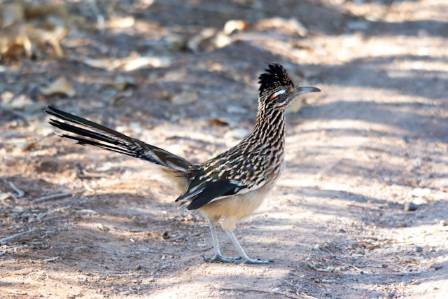
Commonly recognized from their legendary appearances in animation, actual roadrunners are far more complex and intriguing than their cartoon counterparts. These birds belong to the cuckoo family, and while they differ significantly from their relatives in appearance, their vocalizations often consist of a distinct "coo" sound. As primarily ground-dwelling birds, they have evolved a lifestyle centered on speed and agility rather than flight.
Physical Capabilities and Movement
Roadrunners are celebrated for their impressive land speed. On average, they travel at approximately 15 mph, though they are capable of even faster sprints when pursuing prey. While they are often seen casually strolling through their habitat, they can transform into high-speed sprinters the moment they detect a lizard or an insect.
Because they are so effective on their feet, roadrunners rarely take to the sky. They are not particularly strong fliers and generally only use their wings for brief intervals—typically lasting just a few seconds—to escape a predator, reach a high branch, or intercept a flying insect. Their long tail feathers are essential tools for these movements, acting as a rudder to maintain balance whether they are running at full tilt or standing still.
Diversity of Species and Habitat
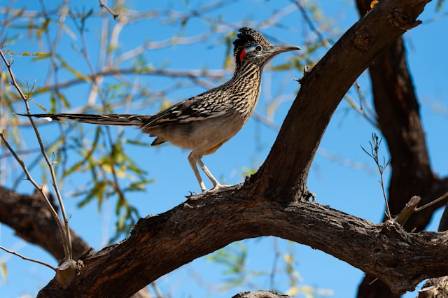
There are two primary species within this group: the greater roadrunner and the lesser roadrunner. The greater roadrunner is the larger variety, reaching lengths of about two feet and featuring a shaggy head crest with speckled white, brown, and black feathers. In contrast, the lesser roadrunner is smaller and possesses a lighter, tan-colored plumage.
The two species occupy distinct geographical areas. Greater roadrunners are common throughout the southwestern United States and various regions of Mexico. The lesser roadrunner’s territory begins where the greater roadrunner’s ends, stretching further south into western Mexico and Central America.
Diet and Survival Tactics
Roadrunners are opportunistic omnivores that consume almost anything they can overpower on the ground. Their diet consists mainly of scorpions, reptiles, rodents, and insects, though they also eat seeds and fruit. Remarkably, they are capable of hunting venomous prey, including rattlesnakes. When targeting a snake, a pair of roadrunners will often work together to distract and strike the creature's head. For smaller prey like lizards or mice, the birds typically seize the animal and beat it against a rock to ensure it is dead before swallowing it.
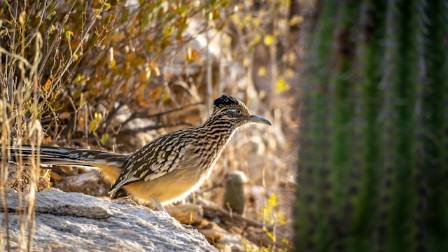
These birds are perfectly adapted to arid desert life. They are so efficient at extracting moisture from their food that they rarely need to find standing water. Their digestive systems are highly effective at absorbing fluids, and they possess specialized salt glands near their eyes. These glands allow them to excrete excess salt from their high-protein diet while conserving precious water.
Evolutionary Background and Social Behavior
Despite their unique appearance, roadrunners are biologically classified as cuckoos. This is evident in their "zygodactyl" feet, which feature two toes pointing forward and two pointing backward, leaving an X-shaped footprint. Like other cuckoos, they have slender bodies and rounded wings.
In terms of social behavior, roadrunners are surprisingly bold and curious. They are known to approach humans and observe them with a tilted head. Many people appreciate their presence because they provide natural pest control by hunting garden-damaging insects and rodents.
Mating and Family Life
Roadrunners generally practice monogamy and may remain with a single partner for their entire lives. Their courtship involves elaborate displays, including foot races and vocalizations. Males often attempt to win over females by offering food, such as a lizard, or nesting materials like sticks and grass.
Once a pair has bonded, they remain together year-round to protect their territory. They build nests in low-lying trees or thick bushes, lining them with leaves and grass. A typical breeding season produces between two and eight eggs, and both parents share the responsibilities of guarding the nest and feeding the hatchlings.
Energy Conservation and Sunbathing
To survive the significant temperature drops of the desert at night, roadrunners enter a state of torpor, a type of light hibernation that lowers their body temperature to save energy. To recover from this state in the morning, they engage in a ritual of sunbathing. By spreading their feathers and exposing their skin to the sun’s rays, they use solar energy to warm their bodies back up to an active temperature.
पास की पत्तियाँ

घर पर रेस्टोरेंट-क्वालिटी के भोजन के लिए 19 फैंसी डिनर रेसिपी
तन्मय

Mastering the Craft of Sand Painting: Creating Vibrant Landscapes
James Winslow

कला और प्रौद्योगिकी के प्रतिच्छेदन की खोज करने वाले 5 दृश्य कलाकार
केयूर

Understanding the Difference Between a Coupe and a Sedan
Nick

Growing Flowers In Your Vegetable Garden - Nasturtiums
Jack Harrison
Mountain Monarchs of Central Asia
Owen Merrick